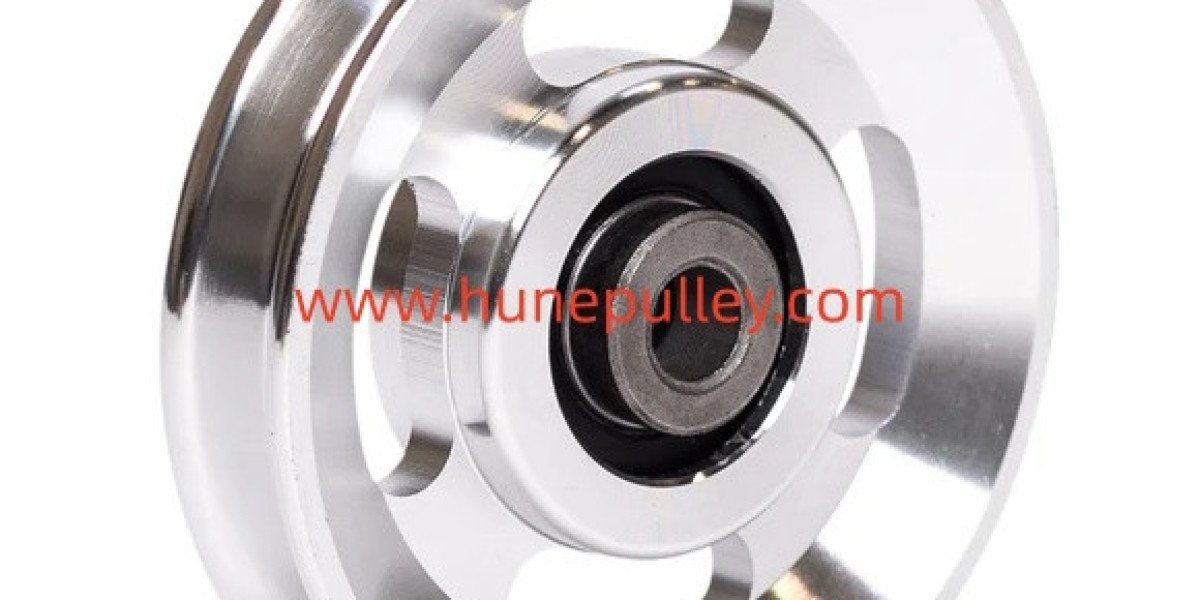

Mechanical movement often depends on components that remain almost invisible during everyday use. A Bearing Pulley Wheel developed by Hunepulley illustrates how a compact hardware element can influence the way a larger system operates. By combining a wheel structure with a bearing arrangement, this type of component can support controlled movement while giving designers another option for developing practical mechanical assemblies.
Movement systems appear in many places around us. Sliding doors, cabinets, furniture mechanisms, equipment structures, and various guiding systems can all rely on wheels or rollers to transfer movement along a defined path. Although their applications may differ, these systems share a common requirement: individual components need to work together in a coordinated way.
The bearing is an important part of this relationship. Its role is to support rotational movement within the wheel assembly, while the surrounding structure determines how the component interacts with a track, shaft, frame, or other surface. Careful consideration of these relationships can help designers select hardware that matches the intended application.
Material choice is another area worth considering. Different operating environments may call for different combinations of wheel materials, bearing structures, and supporting components. Factors such as contact surfaces, installation conditions, surrounding materials, and expected movement patterns can influence the development of a suitable configuration.
Design flexibility can also benefit manufacturers and distributors. A single hardware concept may be adapted for different product categories when dimensions, mounting methods, wheel profiles, or materials are considered carefully. This creates opportunities for businesses to develop product selections around specific applications instead of relying on one generalized solution.
Installation should remain part of the conversation as well. A component can be technically suitable yet inconvenient if it does not integrate naturally with the rest of the system. Mounting structure, alignment, available space, and access for adjustment or maintenance can all influence how effectively a pulley wheel functions after installation.
For product developers, the broader goal is to create harmony between small components and larger mechanisms. A wheel, bearing, track, frame, and moving structure should be considered as connected parts of one system. When their relationships are understood during the design stage, the resulting assembly can become easier to plan and more intuitive to use.
Maintenance is another practical consideration. Hardware used in moving systems may require inspection or replacement over time. Designs that allow components to be accessed and handled conveniently can make routine maintenance more manageable and help businesses think about the complete service life of their products.
For distributors and manufacturers, exploring different pulley configurations can also encourage new product ideas. Small changes in structure can create possibilities for different applications, making component selection an important part of product development rather than an afterthought.
Good mechanical design often begins with details that are easy to overlook. The right component does not need to dominate the system; it simply needs to perform its intended role within it.
If you're looking for a fresh perspective on pulley hardware and mechanical movement, take the next step beyond the familiar. Visit https://www.hunepulley.com/product/ and browse the ideas behind practical motion. Your next design concept may start with a component you never expected to notice.